
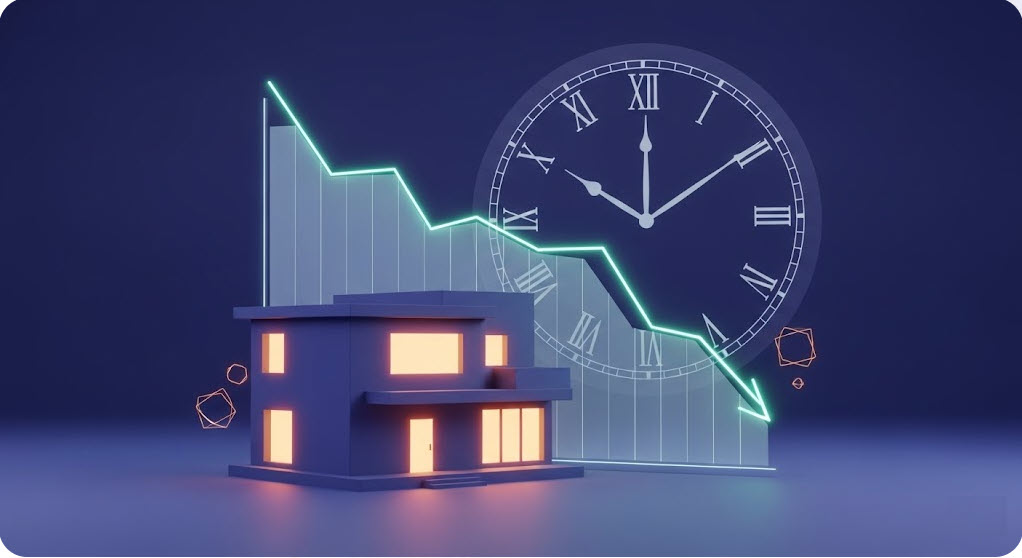
The Calculus of Patience: Strategic Mortgage Liability Management in the 2026 Interest Rate Cycle
Premature Refinancing in early 2026 presents a wealth-destroying trap for homeowners. A rigorous analysis of bond market dynamics, transaction friction, and credit scoring models reveals why the optimal financial strategy is calculated inaction.
The opening weeks of 2026 have ushered in a distinct shift in the United States housing finance sector. After years of monetary tightening that characterized the post-pandemic correction, the 30-year fixed-rate mortgage has finally breached critical resistance levels. Benchmark rates receded to approximately 6.06 percent in January 2026, marking a three-year low that has predictably triggered a surge in mortgage refinance applications. For borrowers holding loans originated at the cycle’s peak, this statistical milestone appears to be the long-awaited signal to act.
Market analysts and behavioral economists caution that this “relief rally” masks a fundamental financial peril. The impulse to execute a mortgage refinance at the first sign of rate moderation often results in a net destruction of borrower wealth. A comprehensive evaluation of the 2026 economic landscape incorporating Federal Reserve policy lags, amortization mathematics, and the emergence of trended credit data suggests that immediate action is statistically inferior to a strategy of waiting. The true window for wealth-optimizing refinancing is projected to materialize not in the first quarter, but as the cycle matures later in the year or into 2027.
The Decoupling of Federal Policy and Mortgage Rates
A primary driver of inefficient refinancing decisions is the persistent misconception regarding the transmission mechanism between the Federal Reserve and consumer borrowing costs. Public discourse often assumes a linear correlation where a reduction in the federal funds rate necessitates an immediate and equal decline in mortgage rates. Quantitative finance demonstrates that this relationship is imperfect and frequently inverse in the short term.
The federal funds rate governs overnight lending between depository institutions and primarily influences short-term liabilities such as credit cards and Home Equity Lines of Credit (HELOCs). In contrast, the 30-year fixed-rate mortgage is a long-duration asset priced against the 10-year U.S. Treasury note. Bond traders manage portfolios worth trillions by forecasting economic conditions well into the future. When data suggests a softening labor market a precursor to Fed rate cuts institutional investors purchase long-term bonds immediately to lock in yields. This buying pressure drives yields down well before any official FOMC announcement.
By the time the Federal Reserve Chair announces a policy shift, the market has often already priced in the benefit. If the central bank’s action merely matches expectations, mortgage rates may remain static or even rise if the accompanying commentary signals long-term inflation concerns. This phenomenon creates a “buy the rumor, sell the news” dynamic that traps reactive borrowers.
A more critical factor for 2026 is the “spread” the difference between the 10-year Treasury yield and the 30-year mortgage rate. Historically averaging 170 basis points, this spread ballooned to nearly 300 basis points due to interest rate volatility and the Federal Reserve’s withdrawal from the Mortgage-Backed Securities (MBS) market. Current mortgage rates thus include a substantial “volatility tax.” As the economy stabilizes throughout 2026, this spread is expected to compress toward historical norms. Borrowers who refinance in January accept an artificially inflated rate. Those who wait for spread compression could realize rate reductions of an additional 50 to 100 basis points purely through market normalization, independent of Treasury yield movements.
The Microeconomic Penalties of Transaction Friction
Beyond macroeconomic theory lies the mathematical reality of transaction costs. A mortgage refinance is the origination of a new financial product rather than a simple administrative adjustment. The friction costs associated with this transaction in 2026 have risen alongside property values. Total refinancing costs typically range between 2 percent and 6 percent of the loan balance when accounting for origination fees, title insurance, and appraisal requirements.
For a standard $350,000 mortgage balance, a 3 percent cost structure equates to $10,500 in capital that must be paid via liquidity or equity erosion. The common “break-even” calculation dividing closing costs by monthly savings fails to account for the time value of money or the probability of future transactions. If a borrower refinances in early 2026 and incurs these costs, they must retain the loan for several years to recoup the expense. However, if rates drift lower by late 2026 as forecasted by Fannie Mae and the Mortgage Bankers Association, the borrower faces a dilemma: refinance again and duplicate the $10,500 cost, or remain trapped in a sub-optimal rate.
This scenario is known as “churning.” It enriches lenders and title insurers while systematically stripping equity from homeowners. Repeatedly capitalizing thousands of dollars in fees into the loan balance can negate the interest savings of a lower rate. The prudent approach involves executing a single transaction at the cycle’s maturity targeting a rate near 5.5 percent, rather than multiple transactions on the way down.
The Amortization Trap and Equity Erosion
The most insidious cost of serial refinancing is the destruction of amortization momentum. A standard U.S. mortgage is structured as an annuity where interest payments are front-loaded. In the early years of a loan, the vast majority of the monthly payment services interest rather than principal.
Refinancing resets this amortization clock. A homeowner who has paid down a mortgage for five years has finally begun to make meaningful progress on the principal balance. By refinancing into a new 30-year term to secure a lower monthly payment, the borrower resets the loan to Year 1. The payment composition reverts to being almost entirely interest.
Quantitative modeling of this “reset fatigue” shows that extending the repayment term significantly increases total interest costs over the life of the asset. A borrower might reduce their monthly obligation by $200 but ultimately pay tens of thousands more in cumulative interest by adding five years to their debt horizon. Unless the monthly savings are rigorously invested at a high rate of return, the borrower’s net worth at the end of the period is often lower than if they had retained the original loan. Strategic borrowers forced to refinance for cash flow reasons should consider 20-year terms to neutralize this effect, though few do so.
Credit Implications in the Era of Trended Data
The decision to refinance frequently carries implications for borrower creditworthiness that have intensified with the adoption of “trended data” models like FICO 10 T. Unlike legacy scoring models that viewed credit as a static snapshot, trended data analyzes 24 months of historical behavior to identify patterns.
Lenders and credit bureaus now scrutinize “credit seeking” behavior more aggressively. While rate shopping within a short window is treated as a single inquiry, inquiries spaced several months apart—typical of a serial refinance strategy are flagged separately. Repeatedly opening new mortgage trade lines lowers the Average Age of Accounts, a key component of the credit score.
For borrowers on the cusp of the “super-prime” tier (780+ FICO), a dip in credit score caused by a premature refinance in January could result in less favorable terms if they attempt to refinance again in October. The very act of chasing a lower rate can damage the credit profile needed to secure the lowest possible rate when the market truly bottoms out.
Regulatory Guardrails and the Seasoning Lock-Out
The mortgage industry has erected structural barriers to prevent rapid loan turnover. “Seasoning” requirements mandate that a loan must be held for a specific period before it can be refinanced again using conventional or government-backed programs.
Fannie Mae and Freddie Mac generally require a 12-month seasoning period for cash-out refinances. A homeowner who executes a rate-and-term refinance in January 2026 effectively locks their equity away until January 2027. If a financial emergency arises in late 2026, the borrower would be barred from accessing their home’s equity via a conventional low-rate mortgage and forced into higher-cost alternatives like personal loans or HELOCs.
Government-backed loans such as VA and FHA products enforce similar “lock-out” periods, typically requiring 210 days and six consecutive on-time payments before a new streamlined refinance is permitted. These regulations are designed to protect investors from prepayment risk but can leave impatient borrowers stranded in an illiquid position if market conditions shift rapidly.
Furthermore, Mortgage Brokers face Early Payoff (EPO) penalties if a borrower refinances within six months of origination. Lenders claw back the broker’s commission in these instances. This creates an adversarial dynamic where high-quality brokers may refuse to work with serial refinancers or charge higher upfront points to hedge their risk.
The Strategic Outlook: The Discipline of Inaction
The convergence of these factors—macroeconomic forecasts, transaction friction, amortization mathematics, and regulatory constraints—creates a definitive argument for patience. The mortgage market of 2026 is normalizing after a period of historic volatility. Forecasts from major institutions including Fannie Mae and the Mortgage Bankers Association indicate that rates will likely stabilize in the mid-to-low 6 percent range for much of the year before drifting lower.
The “sweet spot” for refinancing is likely to emerge in late 2026 or 2027, when Federal Reserve policy has fully permeated the economy and the spread between Treasuries and mortgages has compressed. By waiting for this maturity, borrowers can execute a single, efficient transaction that maximizes interest rate differential while minimizing fees and equity erosion. In a financial environment defined by instant gratification, the most sophisticated wealth management strategy is often the discipline to do nothing until the moment is mathematically optimal.

