Shopping Tips for This Year’s Home Buying Season

A whopping 50 percent of homes are sold in the summer. Even though there can be benefits to buying at other times of the year, you might find that shopping for a home during the traditional home buying season is ideal, since you can go house shopping while the weather is warm and so that you can buy a home and move in-between school years for your kids.


Regardless of why you are choosing to go shopping now for your home, you probably want to make sure that the process goes as smoothly as possible. Luckily, if you follow these tips, you can help ensure that you have the best possible success when shopping for a home.


Set Your Budget First


First of all, you’ll want to set your budget first. There is really no reason to waste your time looking at homes that you can’t afford, after all. Plus, you don’t want to buy more home than you can easily afford, which can make things a lot more stressful once you’re actually in the home and making your mortgage payments.


There are online calculators and basic formulas that you can use when deciding how much of a home you can afford. However, you will generally only want to use these numbers as a starting point. Only you really know how much you feel comfortable paying for a home each month, so it can be worth it for you to sit down, make a budget and get a number in mind of how much house you can afford before you ever start shopping around.


Get Prequalified


If you are unsure of whether or not you will be able to actually qualify for a mortgage, it can pay for you to work with a mortgage lender to get prequalified. Few things can be as upsetting as house shopping and falling in love with a house only to find that you can’t actually buy it because you can’t get approved for the loan. By working with a lender now, you can determine if you will be able to get a mortgage and can get an idea of how much you will get approved for.


Make a List


Before you start shopping, think about the things that are most important to you. You might want to have a certain number of bedrooms to ensure that the home will be a good fit for your family, for example, or you might prefer a home that has a nice, large yard for gardening. Making a list of these things can make it easier for a Real Estate agent to show you homes that you will actually be interested in and can help keep you focused on what you really want so that you don’t start looking at homes that won’t be a good fit.


Don’t Be Afraid to Negotiate


When looking at homes, don’t be afraid to negotiate. In many cases, you can negotiate a lower price on a home. Some sellers are also willing to take certain steps to sweeten the deal and encourage you to choose their home out of the ones that you are looking at, such as by covering closing costs or adding in a budget to swap out the flooring or to paint.


Plan for Other Costs


You shouldn’t just be thinking about the cost of buying the home. You should also be planning for other costs, such as by saving up for closing costs, shopping around for home and auto insurance quotes so that you can secure affordable homeowner’s insurance and thinking about how much you will have to spend in utility deposits and moving expenses.


If you are getting ready to start shopping for your dream home, you probably want to ensure that the process goes smoothly. Luckily, following these tips can help you enjoy the best possible success when shopping for the home of your dreams.


Simple Tricks That Will Turn Your House into a Home


Moving into a new house is exciting, but it’s not necessarily going to feel like home from the very beginning. Luckily, there are plenty of things you can do to make your house start to feel warm and fuzzy. Here are a few tips for turning your house into a home you can’t wait to return to everyday.

Decorate with Your Favorite Colors

One of the best ways to make your home feel like yours is to put your favorite colors around, according to Better Homes and Gardens. Maybe you prefer neutrals and want to stick with a palette that makes you feel calm and relaxed. Maybe you love bold colorsand want to paint one whole wall a bright blue. Whatever color scheme you prefer, surround yourself with it.

Get Something Cooking

Nothing makes a house feel more homey than food cooking or baking. Prepare your favorite meal or put cookies in the oven to fill your home with delicious smells. Try to make something that’s comforting and that reminds you of the meals you used to eat in your previous home or when you were a child. Don’t have time to whip something up? Pick up a candle that smells like fresh baked cookies or another yummy treat.

Showcase Your Experiences

When you look around your new house, you may not spot anything that feels inherently “you.” This is a good time to start framing photos and displaying memories. Dig through childhood photos, pictures from your last vacation, portraits of your family, etc. Even ifyou just tack a few up on the fridge for now, they’ll be a good reminder of your life and everything you love. You can also create little areas with souvenirs and collectibles you’ve picked up during your travels. You can visit this part of your home to reminisce about everything you’ve done.

Start Creating New Rituals

Moving into a new house can upend your rituals and ways of doing things. Start putting new rituals in place right away. According to Good Housekeeping, this is one of the best ways to make your house feel more like home. Plan for Friday movie nights in your your home theater with the family, Sunday morning brunch on the porch, doing yoga together after everyone’s home from work and school, etc.

Decorate with Family Heirlooms

If your family heirlooms spend most of their time tucked away in a closet or basement, pull them out and find a place to display them. Looking at items that belonged to several generations of your family will be comforting and will make your home feel more personal. Plus, they’ll make great conversation pieces whenever you have guests over.

Make Sitting Areas Comfy

If you want to start feeling cozy in your new home, start adding cozy layers to it! According to Pop Sugar, adding a throw to a chair or couch that you love to relax on is the quickest way to make it more comforting and welcoming. It’s also a super simple way to decorate and you can swap out the throw to match the season.

Don’t Worry Too Much About the Mess

When you look around your home and see the remnants of a busy morning or weekend, you’ll be reminded of your family and your experiences. Do
n’t worry too much about keeping your home in tip-top shape every second of the day. The scratches, clutter and flaws are the proof that your house has become a home.

Your house has a specific goal: to provide you with shelter. Your home, on the other hand, is there to help you get through all of the wonderful and difficult parts of life. Turn your shelter into a supportive, welcoming and customized home by surrounding yourself with the items you love and that make you feel most yourself.

Smart Home: Homes of the Future

The Smart Home is the trend of the future. Our world is becoming more computerized and interconnected, and many of the everyday devices that share our homes are beginning to take part in what’s become known as the Internet of Things. In the past several years, remarkable advances in technology have allowed microchips to be made smaller and more cheaply, and easily integrated into some of our most mundane household objects.

We’re growing more sensitive to the increasing cost of energy and the environmental impact of choices that we make as consumers, and the market is demanding higher-efficiency and lower-cost options for the many machines that work for us on a daily basis. Advancements in product design have helped maximize the usage of electricity, gas, and water in our home appliances, and computerization has allowed those advances to go even further. These new technologies are enabling our devices to optimize energy usage, and they’re also providing extra measures of comfort and convenience in our busy lives.

Climate Control

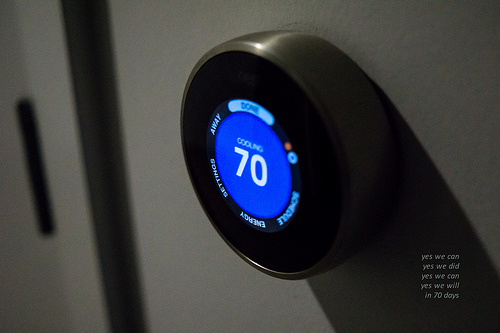
Smart thermostats allow you to remotely control your climate systems, such as heating, cooling, and humidity, as well as set schedules. Some systems can communicate with your phone’s GPS to detect when you’re on your way home and activate systems to ensure that you’ll be comfortable from the moment you walk in the door. Smart vents are able to work in conjunction with your HVAC systems to further optimize climate control, closing off airflow to rooms that are rarely used or controlling temperature room-by-room.

Intelligent Lighting

Like an advanced version of those old-fashioned dial timers we used to plug our lamps into, smart lighting controls allow users to set schedules to turn individual lights on or off at certain hours. Beyond that, new technology enables sensors to detect when you’ve entered or exited a room and adjust lights accordingly or fine-tune the spectrum of the lighting to perk you up in the morning and calm you down as bedtime approaches in the evening.


Security Systems

There is a multitude of wi-fi enabled security systems on the market which allow the user to remotely view security camera feeds and other sensors, some of which are even equipped with cellular connectivity to provide an extra measure of safety in case your wi-fi connection fails. Satellite internet providers that offer advanced end-to-end encryption, such as BusinessCom, can also provide an added measure of security.

Gone are the days when you may have headed to work in the morning to realize halfway through the day that you forgot to lock the door on your way out. Now, with a smart door lock, you can simply pull out your phone, tap the button, and your home is securely locked. Perhaps that scenario will never occur because as you walked out the front door and out of range of your home wi-fi network, your phone sent a signal back to the house and locked the door for you!

Kitchen and Convenience

You’re at the grocery store and can’t remember whether you needed milk. Just pull out your phone and open the fridge to check! Smart refrigerators equipped with wi-fi cameras and information panels are just a single example of the plethora of kitchen and home gadgets that can make your life easier. Coffee makers, ovens, deep fryers, juicers, and even trash cans can be connected to the Internet of Things!

We’re only at the beginning of the smart home revolution. Many of these devices are very reasonably priced, and as the trend goes, they will drop in price as time goes on. Even though we’ve seen amazing advances in Internet of Things technologies, they’re still in their infancy. Only time can tell what’s next!


How To Save For A Home Downpayment

One of the more common ways to build wealth over time is owning a home. As owners pay down the mortgage, they are able to build up equity. Should they decide to sell the home, they can then tap this equity. The homeownership rate in the US was 63.8 percent in October 2016. While this was down from what it was a few years ago, this statistic shows that owning a home is still a popular way to build wealth.

It’s recommended that prospective buyers save up 20 percent of the home’s value as a down payment. This will allow the buyer to avoid private mortgage insurance, which can be quite expensive and only protects the lender. FHA loans only require a 3.5 percent down payment, and loans via the USDA or the VA require no money down. If you’re not in a rural area or a veteran, here are some ways to build up the down payment that’s necessary to buy a new home.

Live In Affordable Accommodations

When it comes to the biggest expenses that most people will have on a monthly basis, the cost of lodging will usually come up near the top of the list. The average cost of rent in the United States is $1,231 a month. That’s more than a quarter of the median family income. The best way to save money on rent is to find a place to live that’s on the low side of the local market rate. While there won’t be as many amenities in cheap apartments or homes, the money that’s not spent in the way of housing can go toward savings.

Just getting a cheap apartment is not the only way to save money toward a down payment. Getting a roommate can also help cut the cost of rent and free up even more cash flow for savings. For example, a three-bedroom apartment or house that costs the median of $1,200 could cost only $400 a month if one person rented out each bedroom. Put in some twin beds, and the cost could be lower. Even a married couple could rent out a room or two to save on costs. Every dollar saved on rent can then go toward saving up for a future down payment.


Cut Other Expenses

Americans are notorious for spending more money than they need to. Whether it’s a daily latte or cable television, people in the US confuse wants and needs. Basic food, lodging, clothing and transportation are necessary to live and have a job. Most everything else is a want, and there are ways to cut down on these expenses. For example, it’s not necessary to have a super expensive cell plan with unlimited data. There are prepaid options that are pretty cheap. Additionally, it’s possible to cut down on eating out or save some money by opting for Netflix or Hulu rather than an expensive cable package with every pay channel known to man. Every dollar saved from cutting out unnecessary expenses can then go toward a down payment.


Get A Side Hustle

Sometimes, one job just doesn’t pay enough to save much. This is where a side hustle can come in quite handy. There are entire online communities that are dedicated to helping people find side hustles that can bring in extra income. Every dollar earned in excess of basic living expenses can go toward the down payment. Those who can keep up the side hustle after signing off on a mortgage can even accelerate the time needed to pay off the loan.

Regardless of whether a person thinks a down payment for a new home is in the cards, there are steps that he or she can take to build up some savings. It will take time, and it’s a good idea to save up for closing costs and a deductible for home insurance claims. However, over time, building up savings for a down payment can be done by taking positive steps toward the goal.


The Right Neighborhood for Your Family

Choosing a neighborhood in which to raise your family can seem like a daunting task. It’s not easy to point to a place on a map and decide to put down roots and stay for years to come. Buying a home is a significant investment, and you want to be sure you’re picking the best area possible to meet the needs of your family. But you don’t have to wait to learn about your neighborhood until after you’ve already closed escrow. Here are some resources to help you research your future neighborhood ahead of time, enabling you to choose the best place to raise your family.

Look at Local School Ratings

The easiest way to find a neighborhood where you feel comfortable raising your family is to look at nearby school ratings. The website Great Schools is an incredible resource that ranks schools based on test scores and parental reviews. Simply type in the generic city or metropolitan area you’d like to live in, and look at the map to see the results. You can customize the map to only display the types of schools you’re looking for, like high schools vs. preschools. It’s easy to see where the best neighborhoods are because they typically have the highest rated schools. Once you have narrowed it down to a more specific area, GreatSchools.org will even show you individual school attendance boundaries to make searching for a home even easier.

Research Crime Statistics

It’s not enough to find a neighborhood that has good schools. Crime levels are another very important factor in any home search. Use local municipal websites or sheriff’s department websites to find out what types of crimes are being committed in the area you have chosen. NeighborhoodScout is another great resource that shows the different types of crimes in any given area. Crime is everywhere, so don’t be too alarmed when you see multiple incidents show up in your desired area. The important thing is to look at what types of crimes are being committed in your area. Are they petty crimes like a teenager stealing a lawn chair, or are they something much more serious like armed robbery and home invasion? Doing research on local crime statistics is a great way to get to know the neighborhood long before you’re committed to moving in.

Search for Nearby Amenities

Once you have settled on a neighborhood, look at the amenities that are available nearby to see if they meet your family’s needs. Check local city and county websites to locate nearby public parks and swimming pools. Look up children’s classes and activities that may be offered through your local community center. Check national and state park websites to find out if there are any state-run nature facilities nearby. Don’t forget to look for amenities for the adults as well. Are there coffee shops and restaurants nearby? What about a gym, and a grocery store? These are all things that impact quality of life and contribute to a neighborhood’s overall desirability.

Housing

Once you have chosen a neighborhood, research all the housing options for your family. Even if you are using an agent (as you should), check homes that are selling by owner. Often times homes in the best neighborhoods are sold by word of mouth before they even hit the market. Talk to people in the area and try to get the inside scoop to be sure you can find a home in your desired neighborhood.

Don’t be intimidated when trying to choose a neighborhood for your family. Doing research online before you begin house hunting can help save you a lot of wasted time and can help take a lot of the unknowns out of moving to a new area. Follow these tips and help make your next move a little more certain, and help you rest assured that you are moving your family into the best neighborhood possible.