
The Calculus of Patience: Strategic Mortgage Liability Management in the 2026 Interest Rate Cycle

The Calculus of Patience: Strategic Mortgage Liability Management in the 2026 Interest Rate Cycle

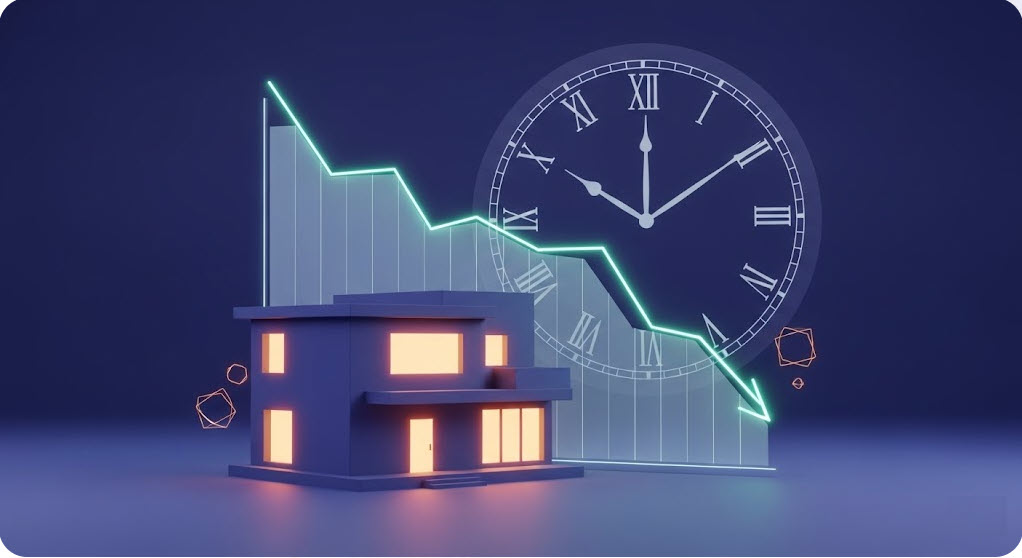
Premature Refinancing in early 2026 presents a wealth-destroying trap for homeowners. A rigorous analysis of bond market dynamics, transaction friction, and credit scoring models reveals why the optimal financial strategy is calculated inaction.

The opening weeks of 2026 have ushered in a distinct shift in the United States housing finance sector. After years of monetary tightening that characterized the post-pandemic correction, the 30-year fixed-rate mortgage has finally breached critical resistance levels. Benchmark rates receded to approximately 6.06 percent in January 2026, marking a three-year low that has predictably triggered a surge in mortgage refinance applications. For borrowers holding loans originated at the cycle’s peak, this statistical milestone appears to be the long-awaited signal to act. 

Market analysts and behavioral economists caution that this “relief rally” masks a fundamental financial peril. The impulse to execute a mortgage refinance at the first sign of rate moderation often results in a net destruction of borrower wealth. A comprehensive evaluation of the 2026 economic landscape incorporating Federal Reserve policy lags, amortization mathematics, and the emergence of trended credit data suggests that immediate action is statistically inferior to a strategy of waiting. The true window for wealth-optimizing refinancing is projected to materialize not in the first quarter, but as the cycle matures later in the year or into 2027.

The Decoupling of Federal Policy and Mortgage Rates

A primary driver of inefficient refinancing decisions is the persistent misconception regarding the transmission mechanism between the Federal Reserve and consumer borrowing costs. Public discourse often assumes a linear correlation where a reduction in the federal funds rate necessitates an immediate and equal decline in mortgage rates. Quantitative finance demonstrates that this relationship is imperfect and frequently inverse in the short term. 

The federal funds rate governs overnight lending between depository institutions and primarily influences short-term liabilities such as credit cards and Home Equity Lines of Credit (HELOCs). In contrast, the 30-year fixed-rate mortgage is a long-duration asset priced against the 10-year U.S. Treasury note. Bond traders manage portfolios worth trillions by forecasting economic conditions well into the future. When data suggests a softening labor market a precursor to Fed rate cuts institutional investors purchase long-term bonds immediately to lock in yields. This buying pressure drives yields down well before any official FOMC announcement. 

By the time the Federal Reserve Chair announces a policy shift, the market has often already priced in the benefit. If the central bank’s action merely matches expectations, mortgage rates may remain static or even rise if the accompanying commentary signals long-term inflation concerns. This phenomenon creates a “buy the rumor, sell the news” dynamic that traps reactive borrowers. 

A more critical factor for 2026 is the “spread” the difference between the 10-year Treasury yield and the 30-year mortgage rate. Historically averaging 170 basis points, this spread ballooned to nearly 300 basis points due to interest rate volatility and the Federal Reserve’s withdrawal from the Mortgage-Backed Securities (MBS) market. Current mortgage rates thus include a substantial “volatility tax.” As the economy stabilizes throughout 2026, this spread is expected to compress toward historical norms. Borrowers who refinance in January accept an artificially inflated rate. Those who wait for spread compression could realize rate reductions of an additional 50 to 100 basis points purely through market normalization, independent of Treasury yield movements. 

The Microeconomic Penalties of Transaction Friction

Beyond macroeconomic theory lies the mathematical reality of transaction costs. A mortgage refinance is the origination of a new financial product rather than a simple administrative adjustment. The friction costs associated with this transaction in 2026 have risen alongside property values. Total refinancing costs typically range between 2 percent and 6 percent of the loan balance when accounting for origination fees, title insurance, and appraisal requirements.

For a standard $350,000 mortgage balance, a 3 percent cost structure equates to $10,500 in capital that must be paid via liquidity or equity erosion. The common “break-even” calculation dividing closing costs by monthly savings fails to account for the time value of money or the probability of future transactions. If a borrower refinances in early 2026 and incurs these costs, they must retain the loan for several years to recoup the expense. However, if rates drift lower by late 2026 as forecasted by Fannie Mae and the Mortgage Bankers Association, the borrower faces a dilemma: refinance again and duplicate the $10,500 cost, or remain trapped in a sub-optimal rate. 

This scenario is known as “churning.” It enriches lenders and title insurers while systematically stripping equity from homeowners. Repeatedly capitalizing thousands of dollars in fees into the loan balance can negate the interest savings of a lower rate. The prudent approach involves executing a single transaction at the cycle’s maturity targeting a rate near 5.5 percent, rather than multiple transactions on the way down. 

The Amortization Trap and Equity Erosion

The most insidious cost of serial refinancing is the destruction of amortization momentum. A standard U.S. mortgage is structured as an annuity where interest payments are front-loaded. In the early years of a loan, the vast majority of the monthly payment services interest rather than principal. 

Refinancing resets this amortization clock. A homeowner who has paid down a mortgage for five years has finally begun to make meaningful progress on the principal balance. By refinancing into a new 30-year term to secure a lower monthly payment, the borrower resets the loan to Year 1. The payment composition reverts to being almost entirely interest.

Quantitative modeling of this “reset fatigue” shows that extending the repayment term significantly increases total interest costs over the life of the asset. A borrower might reduce their monthly obligation by $200 but ultimately pay tens of thousands more in cumulative interest by adding five years to their debt horizon. Unless the monthly savings are rigorously invested at a high rate of return, the borrower’s net worth at the end of the period is often lower than if they had retained the original loan. Strategic borrowers forced to refinance for cash flow reasons should consider 20-year terms to neutralize this effect, though few do so. 

Credit Implications in the Era of Trended Data

The decision to refinance frequently carries implications for borrower creditworthiness that have intensified with the adoption of “trended data” models like FICO 10 T. Unlike legacy scoring models that viewed credit as a static snapshot, trended data analyzes 24 months of historical behavior to identify patterns.

Lenders and credit bureaus now scrutinize “credit seeking” behavior more aggressively. While rate shopping within a short window is treated as a single inquiry, inquiries spaced several months apart—typical of a serial refinance strategy are flagged separately. Repeatedly opening new mortgage trade lines lowers the Average Age of Accounts, a key component of the credit score.

For borrowers on the cusp of the “super-prime” tier (780+ FICO), a dip in credit score caused by a premature refinance in January could result in less favorable terms if they attempt to refinance again in October. The very act of chasing a lower rate can damage the credit profile needed to secure the lowest possible rate when the market truly bottoms out.

Regulatory Guardrails and the Seasoning Lock-Out

The mortgage industry has erected structural barriers to prevent rapid loan turnover. “Seasoning” requirements mandate that a loan must be held for a specific period before it can be refinanced again using conventional or government-backed programs.

Fannie Mae and Freddie Mac generally require a 12-month seasoning period for cash-out refinances. A homeowner who executes a rate-and-term refinance in January 2026 effectively locks their equity away until January 2027. If a financial emergency arises in late 2026, the borrower would be barred from accessing their home’s equity via a conventional low-rate mortgage and forced into higher-cost alternatives like personal loans or HELOCs.

Government-backed loans such as VA and FHA products enforce similar “lock-out” periods, typically requiring 210 days and six consecutive on-time payments before a new streamlined refinance is permitted. These regulations are designed to protect investors from prepayment risk but can leave impatient borrowers stranded in an illiquid position if market conditions shift rapidly.

Furthermore, Mortgage Brokers face Early Payoff (EPO) penalties if a borrower refinances within six months of origination. Lenders claw back the broker’s commission in these instances. This creates an adversarial dynamic where high-quality brokers may refuse to work with serial refinancers or charge higher upfront points to hedge their risk.

The Strategic Outlook: The Discipline of Inaction

The convergence of these factors—macroeconomic forecasts, transaction friction, amortization mathematics, and regulatory constraints—creates a definitive argument for patience. The mortgage market of 2026 is normalizing after a period of historic volatility. Forecasts from major institutions including Fannie Mae and the Mortgage Bankers Association indicate that rates will likely stabilize in the mid-to-low 6 percent range for much of the year before drifting lower.

The “sweet spot” for refinancing is likely to emerge in late 2026 or 2027, when Federal Reserve policy has fully permeated the economy and the spread between Treasuries and mortgages has compressed. By waiting for this maturity, borrowers can execute a single, efficient transaction that maximizes interest rate differential while minimizing fees and equity erosion. In a financial environment defined by instant gratification, the most sophisticated wealth management strategy is often the discipline to do nothing until the moment is mathematically optimal.


Your Path to Homeownership After Bankruptcy: A Crestico Guide

Your Path to Homeownership After Bankruptcy: A Crestico Guide

Facing bankruptcy can feel like a major setback, especially when your dream is to own a home. The uncertainty about your financial future and credit score can be overwhelming. But here’s the good news: bankruptcy is not a permanent roadblock to securing a mortgage. At Crestico, we believe in second chances, and our team of Real Estate and mortgage experts is here to show you that buying a house after bankruptcy is an achievable goal.

This guide will demystify the process, outline the necessary waiting periods, and provide a clear action plan to get you back on the path to homeownership.

Understanding Chapter 7 Bankruptcy and Mortgage Eligibility

Chapter 7 bankruptcy, often called a “liquidation” or “fresh start” bankruptcy, is designed to wipe away most of your unsecured debts, like credit card balances and personal loans. While this provides significant financial relief, it leaves a serious mark on your credit report, where it can remain for up to 10 years.

For mortgage lenders, a recent Chapter 7 filing signals a higher risk. As a result, they impose a mandatory “seasoning period” before they will consider your home loan application.

  • Conventional Loans: Typically require a waiting period of 4 years from the discharge date.
  • FHA & VA Loans: Offer a much shorter waiting period, usually just 2 years from the discharge date.
  • USDA Loans: Generally require a waiting period of 3 years post-discharge.

What lenders look for after the waiting period: Your goal during this time is to prove your financial recovery. Lenders will want to see a solid history of on-time payments for any new credit, stable employment, and a healthy debt-to-income (DTI) ratio. Demonstrating that the bankruptcy was a one-time event caused by circumstances beyond your control (like a medical emergency or job loss) can also strengthen your application.

The Chapter 13 Bankruptcy Path to a Mortgage

Chapter 13 bankruptcy is a “reorganization” plan. Instead of liquidating assets, you enter into a court-approved plan to repay a portion of your debts over a three- to five-year period. Because you are actively repaying creditors, lenders often view a Chapter 13 filing more favorably than a Chapter 7. This can open doors to mortgage eligibility much sooner.

  • Getting a Mortgage During Chapter 13: Believe it or not, this is possible. Lenders like the FHA may approve your mortgage application after you have made at least 12 months of on-time payments under your repayment plan. You will also need permission from the bankruptcy court trustee.
  • Getting a Mortgage After Chapter 13: Once your Chapter 13 plan is complete and discharged, the waiting periods are generally shorter than with Chapter 7.
    • FHA & VA Loans: The waiting period can be as short as 2 years from the discharge date, though some lenders may consider you even sooner.
    • Conventional Loans: The waiting period is typically 2 years from the discharge date or 4 years from the dismissal date.

Your Post-Bankruptcy Action Plan: Rebuilding for Mortgage Success

Simply waiting out the required period isn’t enough. You need to actively rebuild your financial profile to become an attractive borrower. Here are the essential steps our mortgage advisors at Crestico recommend:

  1. Re-establish Your Credit (Wisely): Your credit score will take a significant hit after bankruptcy. The best way to rebuild is to open two or three new lines of credit. A secured credit card is an excellent starting point. Use it for small, planned purchases and pay the balance in full every single month. This demonstrates responsible credit management.
  2. Monitor Your Credit Report: Sign up for a credit monitoring service and check your reports from all three bureaus (Equifax, Experian, and TransUnion) regularly. Ensure all discharged debts are correctly reported as “discharged in bankruptcy” with a zero balance.
  3. Maintain Stable Employment: Lenders prioritize stability. A consistent two-year history of employment, preferably with the same employer or in the same field, shows you have a reliable source of income to handle future mortgage payments.
  4. Save, Save, Save: A larger down payment can significantly improve your chances of approval. It reduces the lender’s risk and shows your commitment to the investment. Saving also helps cover closing costs and establishes a healthy financial cushion.
  5. Keep Your DTI Ratio Low: Your debt-to-income ratio is the percentage of your gross monthly income that goes toward paying your monthly debt payments. After bankruptcy, keep this ratio as low as possible by avoiding new car loans or other significant debts.

The Crestico Advantage: Your Partner in Homeownership

Navigating the mortgage process after bankruptcy can be complex, but you don’t have to do it alone. The rules vary by loan type and lender, and having an experienced guide on your side is critical.

The team at Crestico specializes in helping clients in all financial situations. We understand the nuances of FHA, VA, and conventional loans post-bankruptcy and have strong relationships with lenders who are willing to look beyond the numbers. We can help you create a personalized roadmap to rebuild your credit, determine the right time to apply, and position you for a successful mortgage approval.

Don’t let a past bankruptcy define your future. Contact Crestico today for a free, no-obligation consultation, and let’s take the first step toward your new home together.

First-Time Buyer: Planning for the Total Cost of Buying a House

First-Time Buyer: Planning for the Total Cost of Buying a House

If you are at the same time excited and terrified at the prospects of purchasing your first house, don’t worry, you are not the only one. This is probably the largest financial venture you will undertake so it is natural to be a bit nervous and to wish to research everything in detail so you can feel comfortable as much as possible. With that in mind, here is a list of certain expenses you need to keep in mind when you are planning the budget for your first home.

Prepare for the down payment

Everyone who has purchased a house, vehicle or other more expensive asset had to prepare for the down payment. It represents a portion of your new house’s price which is paid upfront and it can go up to 20 percent of that sum. For instance, if the house costs $200,000, the down payment would be $40,000 and if you saved up that amount, that means that you would have to acquire another $160,000 through a bank loan or some other financial scheme. Both your savings and the manner you would obtain the rest of the sum is something you need to plan for in advance to make sure you come up with the optimal solution when it comes to monthly installments and the length of the payment period. 

2

Keep in mind the house insurance

Taking out home and contents insurance is a small pre-purchase step which could mean a lot in case something happens. One of the most important features you should pay attention to is the 24/7 assistance, while others that could be of use include temporary accommodation in case the damage is substantial and counseling after a traumatic event. The insurance costs vary varies from property to property, and you can click here for home and contents insurance reviews to get more familiar with the conditions and choose the option which would suit you the most. Some things you need to ensure your new home and belongings against are fire, earthquake, storm, flood, and make sure you read the small print and to know exactly what is covered by the insurance.

Anticipate building inspection costs

Since you are buying a house for the first time, you probably don’t have much experience with assessing the offer and there is a reasonable fear among many people when they start looking for the first property that they might overpay for a place. This is why building inspection is a perfect manner to check the structural soundness so you don’t pay too much for a house that is essentially better to be knocked down and built again. These inspections usually cost up to $600 which is not a big amount, considering that it gives you peace of mind regarding a long-term investment that is much larger.

1024×683-tax-free-moving-expenses

Don’t forget the moving expenses

In all the commotion regarding finding the perfect place and arranging the finances to purchase it, many people forget about moving. Since your belongings won’t magically appear in your new home, you need to take it very seriously, as well as the incurred expenses. Besides a lot of hard work related to decluttering, organizing items and cleaning the place, you will need packing supplies and a truck or a moving crew to transfer your things to the new place. Also, some people go for moving insurance, just to make sure they are safe if anything gets broken or damaged during a move, which is not impossible, having in mind the amount of (semi)fragile belongings that you might have. 

When you think you’ve found your dream house, before saying ‘I do’ to it, sit and think about all the expenses and plan your budget well so you can make sure that you having everything under control. That is the only manner you will be able to truly enjoy your new house and to consider it ‘home sweet home’.

Are Loan Officers (LO) legally liable for their company’s comp plan?

Section 129B(d) of TILA, as added by the Dodd-Frank Act, permits consumers to bring actions against individual mortgage loan originators for violations of certain provisions of TILA.  For example, while LO’s can be held personally liable for receiving compensation in violation of the Rule, they are not personally liable under TILA/LO Comp for failing to maintain the records of compensation required by the rule.  The LO Comp Rule, which implements the DFA’s statutory authority confirms this personal liability through its changes to Reg. Z’s definitions. Specifically, the change to § 1026.36 (a)(1)in the LO Comp Rule clarifies the definition of “loan originator” to mean either the individual LO or the company.  The following is from the CFPB’s small business compliance guide which seeks to use plain language explanations for the Rule (although it still warns you that you need to see the actual Rule for details):  “A “loan originator” is either an “individual loan originator” or a “loan originator organization.” “Individual loan originators” are natural persons, such as individuals who perform loan origination activities and work for Mortgage Brokerage firms or creditors.  “Loan originator organizations” are generally loan originators that are not natural persons, such as mortgage brokerage firms and sole proprietorships”

TILA is confusing for a lot of reasons, but one of the biggest areas of confusion in the LO Comp and Ability to Repay rules are the differing obligations imposed on “Creditors”, “Loan Originators”, and “Loan Originator Organizations”.  These definitions are critical in determining who is responsible for any obligation under TILA.  LO comp is one of the few times where the obligation extends all the way down to the individual LO, but the liability is potentially huge. I don’t know about the issue from the LO’s perspective (ask an attorney; see below) – does the borrower have a life of loan defense? As best I understand it, the life of loan defense is true as it relates to foreclosure but the remedy is not a free house, it is three years of interest and other fees (loan, attorney) – a monetary judgment. So there shouldn’t be any runs on any particular company.

Attorney Brad Hargrave (MedlinHargrave) writes, “Loan originator compensation is one area of Truth in Lending and Regulation Z wherein someone other than a creditor; namely, the loan originator, can also be held liable for a violation.  The citation in support of this proposition is found at 15 USC §1639b(d)(1) which provides, in pertinent part, that ‘for purposes of providing a cause of action for any failure by a mortgage originator, other than a creditor, to comply with any requirement under this section, and any regulation prescribed under this section, section 1640 shall be applied with respect to any such failure by substituting ‘mortgage originator’ for ‘creditor’ each place such term appears in each such subsection.’  And, §1640 is that section of TILA that imposes civil liability for various TILA violations, including those sections regarding LO Compensation.  (I have not addressed the recoupment and setoff issues in the event of foreclosure in the context of the LO, given that an LO would not be the party initiating the foreclosure; and thus, this section really isn’t applicable to an LO).”

Mr. Hargrave’s note continues, “The penalties are potentially severe. In an individual civil action brought by a consumer, the creditor who paid the violative compensation could be liable to the borrower for actual damages, plus twice the amount of any finance charge in the transaction (capped at $4,000), plus an amount equal to the sum of all finance charges and fees paid by the consumer (unless the creditor can demonstrate that the failure to comply is not material), plus reasonable attorneys’ fees and court costs if the borrower were to prevail.  The loan originator’s exposure to such a claim (per 15 USC § 1639b(d)(2))is the greater of actual damages to the consumer or three times the total amount of direct and indirect compensation paid to the LO in connection with the subject loan, plus the costs to the consumer of the action, including reasonable attorneys’ fees.  In addition, the CFPB could sue the creditor and the loan originator in Federal District Court and seek any one of a number of remedies, including restitution and/or disgorgement, and appropriate injunctive relief, as to all loans wherein the LO received unlawful compensation.  It is also possible that the matter could be referred to another agency for enforcement.”

Helpful Tips To Guide You In Buying Your First Home

Buying a home can be very exciting! It’s part of the "dream" we all have for ourselves, the marriage, the family, the pet, the white picket fence – all of these things are dependent on having a home. Having means owning, not renting; to those of us wishing to make the most of our hard-earned money. But making the most of your money is not always easy – it takes a little bit of savvy and a lot of consideration.

Consideration means research, research and some more research. You need to know the facts. Not just about the home you are buying, but also the city, community, history and future projections, to help you determine whether this investment is right for you. While buying a home is not permanent – it is long term and you need to make sure the home you select matches your long-term lifestyle choices.

Budgeting – this is key! You do not want to get yourself into a home you cannot comfortably afford, or you will end up working and never being home to enjoy it; or unfortunately even potentially risking losing it or other valuable items in your life.

•Get familiar with home buying terminology. Know the difference between the types of loans, insurance, Interest Rates and programs available to you.

•Figure out your budget. Work with your loan consultant to determine what you can actually afford to pay on a monthly basis. Remember, a mortgage payment is not just principal and interest, there are taxes and insurance that will need to be paid. Also, the community you select a home in may have a homeowner’s association that charges a monthly fee. These are all in addition to the increased utilities, maintenance and potentially security costs that go along with owning a home. Remember, there no "super" to call when that toilet gets clogged!

•Get rid of your old bills! You’ll have lots of new bills to replace those! Try to pay off all your existing credit card bills. The less debt you have, the better loan you will qualify for.

• Read your paper work. HUD has a handy booklet on its site called "Buying Your Home: Settlement Costs and Helpful Information." It describes the home buying and settlement process and explains most of the expenses you will encounter. Although your lender will give you a copy, it’s a good idea to read it before you even consider applying for a loan.

• Ask questions. Make sure your loan and Real Estate consultants are the kind of people who take the time to explain every single step of the process and answer each of your questions. They are there to serve YOU! Buying a home is a serious decision and the people helping you should appreciate the opportunity to serve you. The service you receive should be attentive, respectful and consistent!


For more information, please visit www.crestico.com.